The tribe

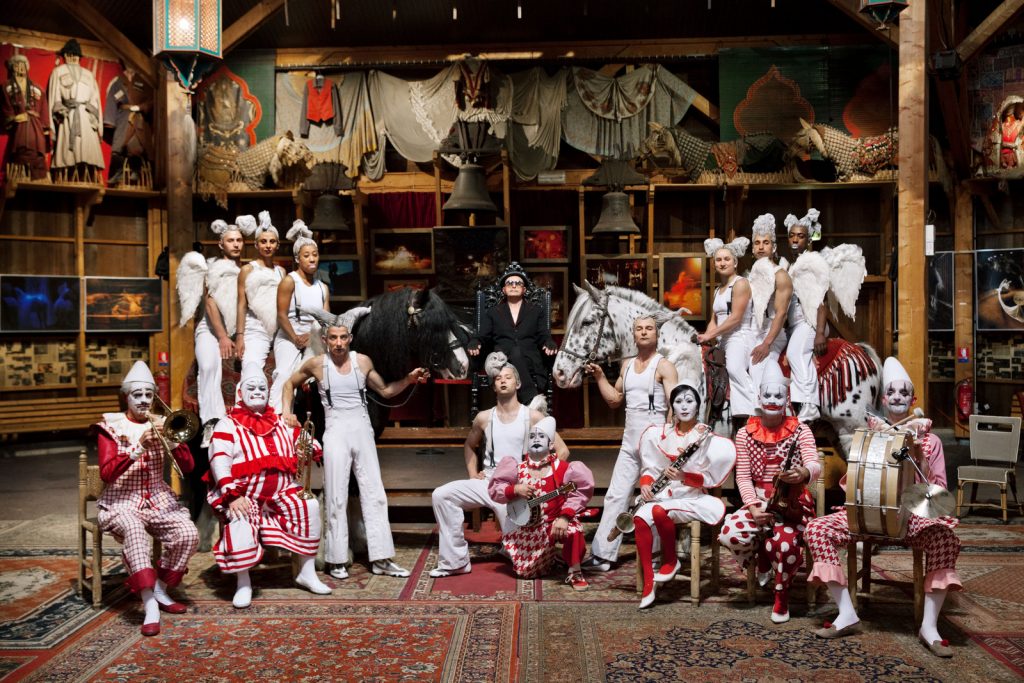
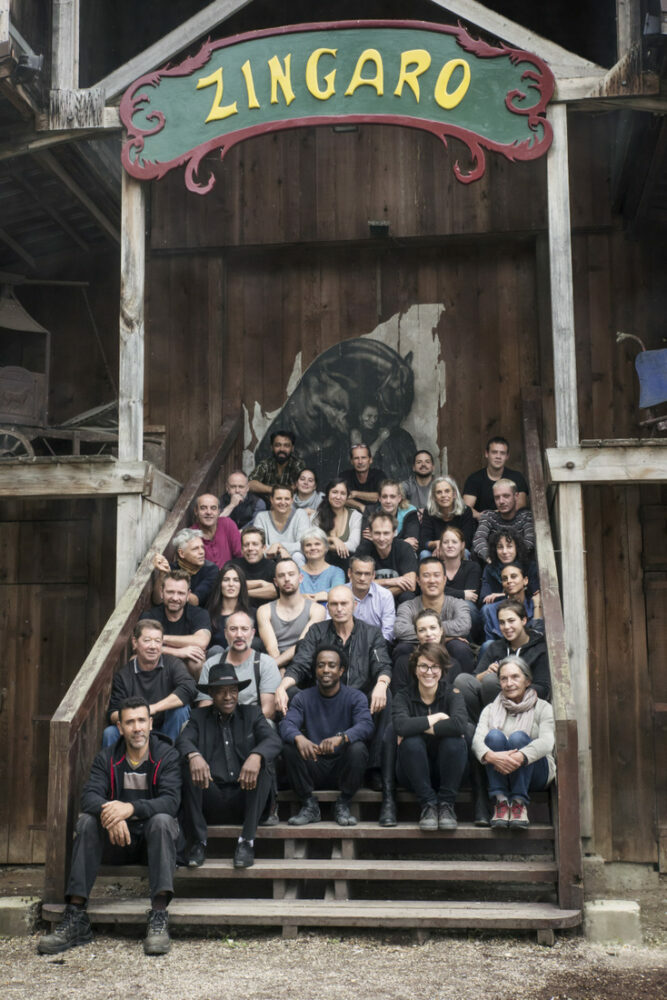
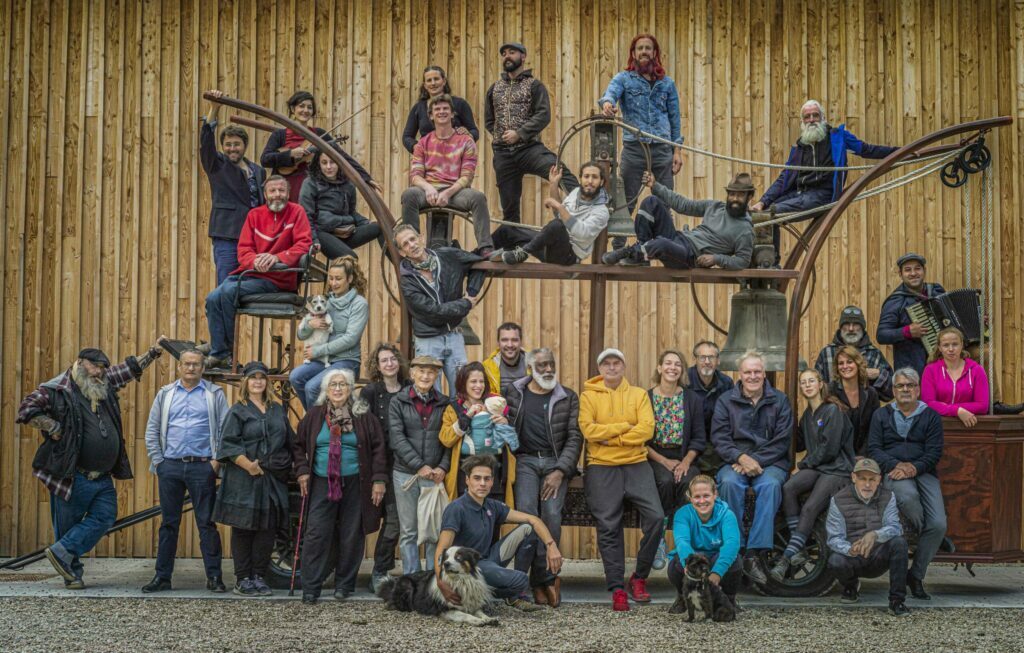
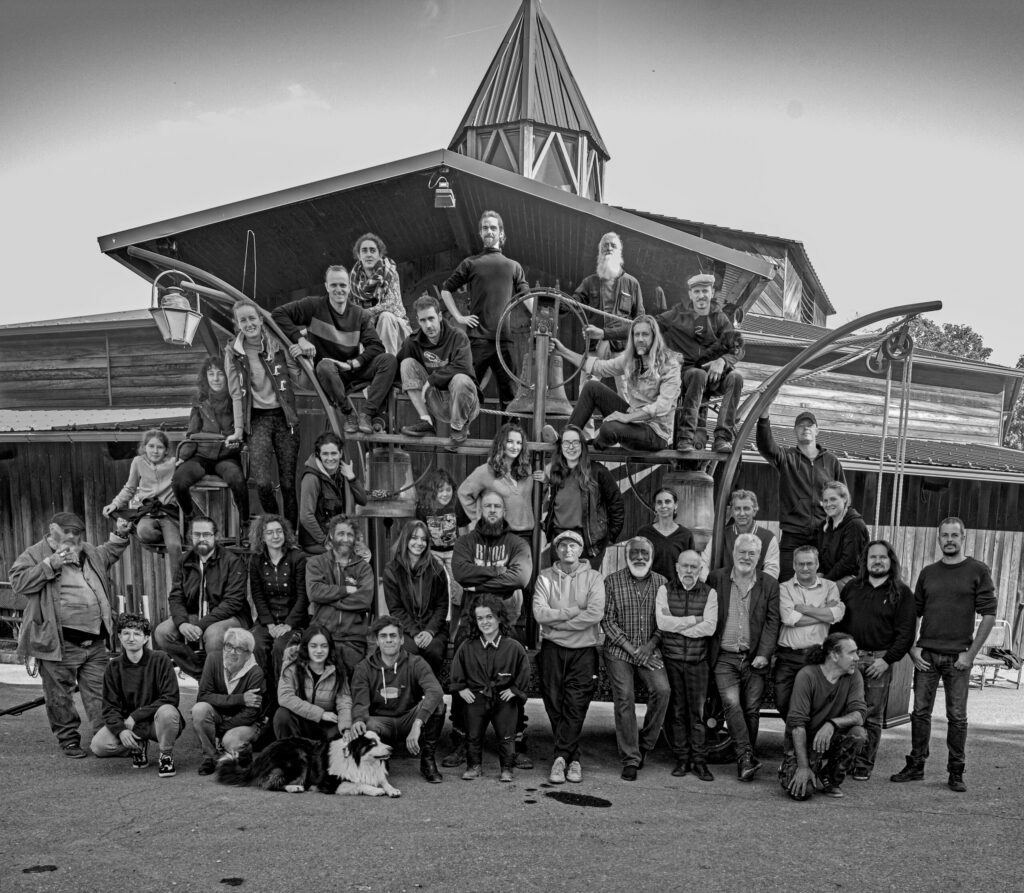
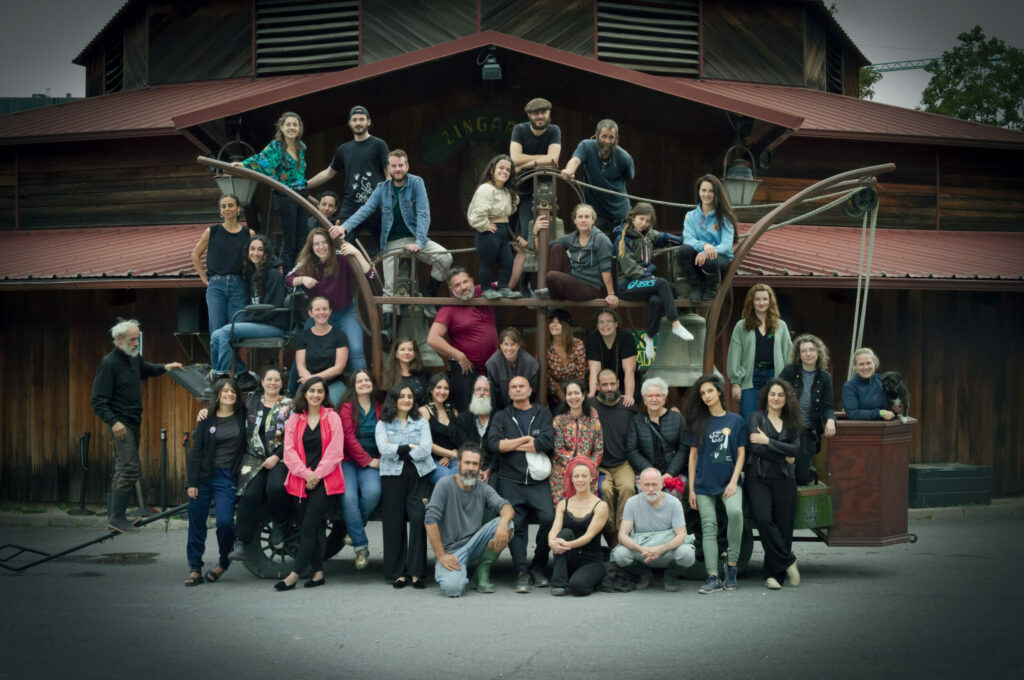
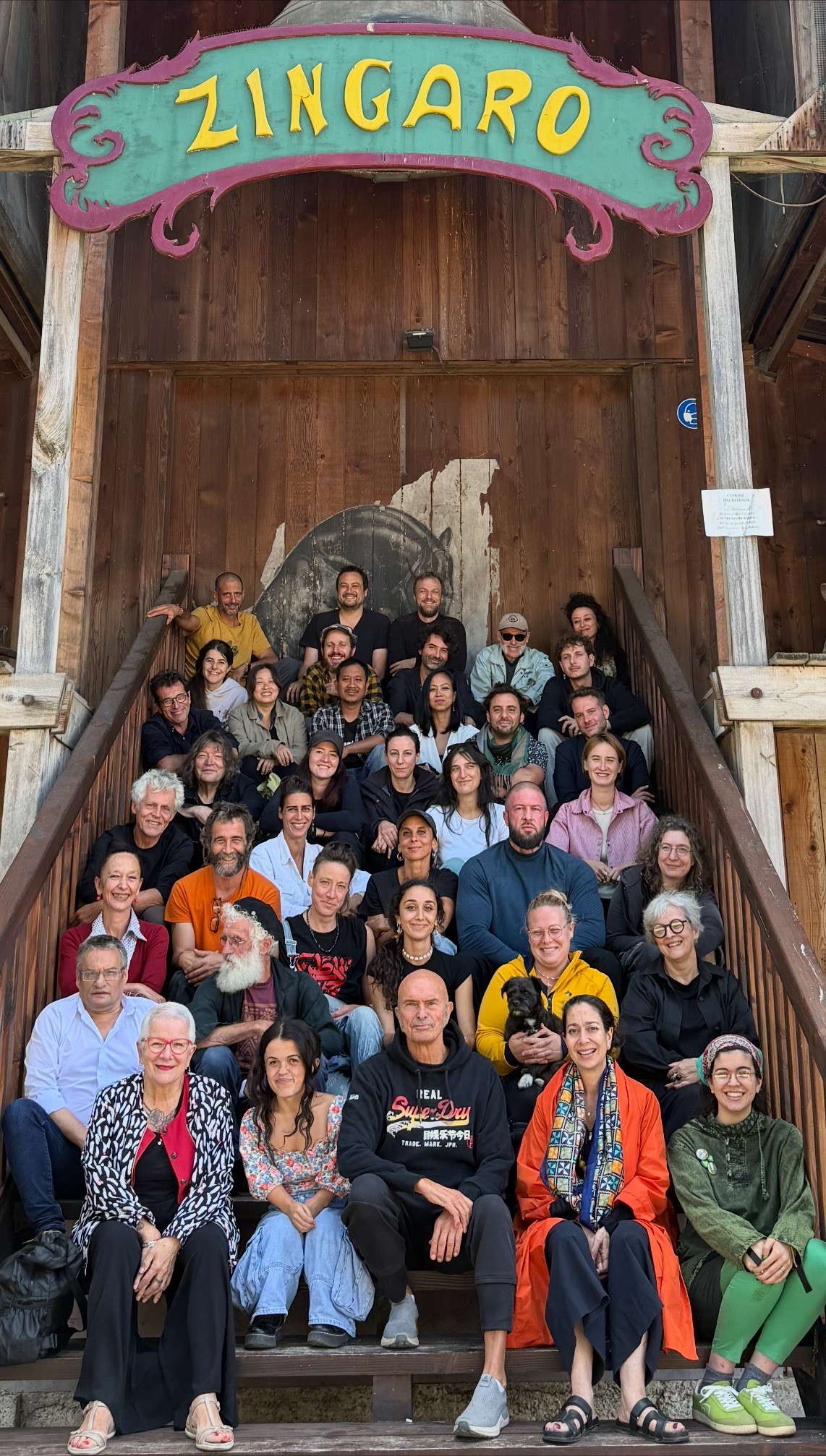
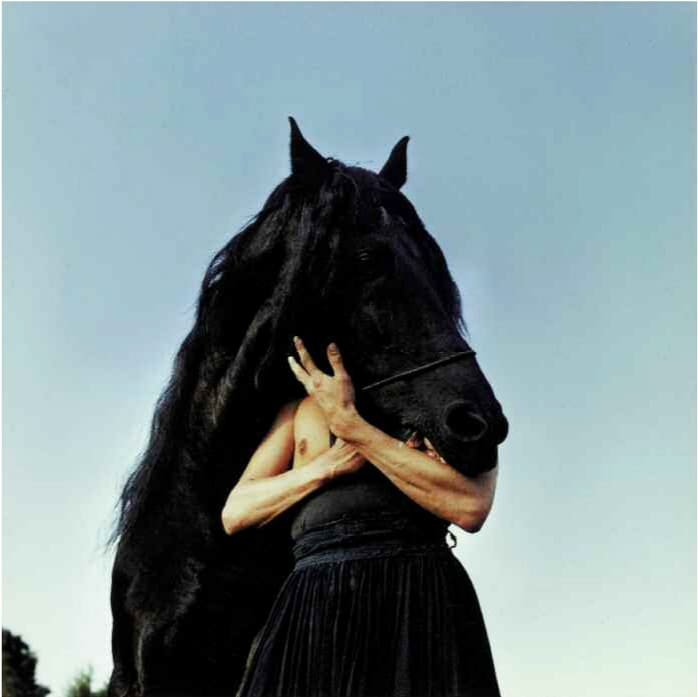
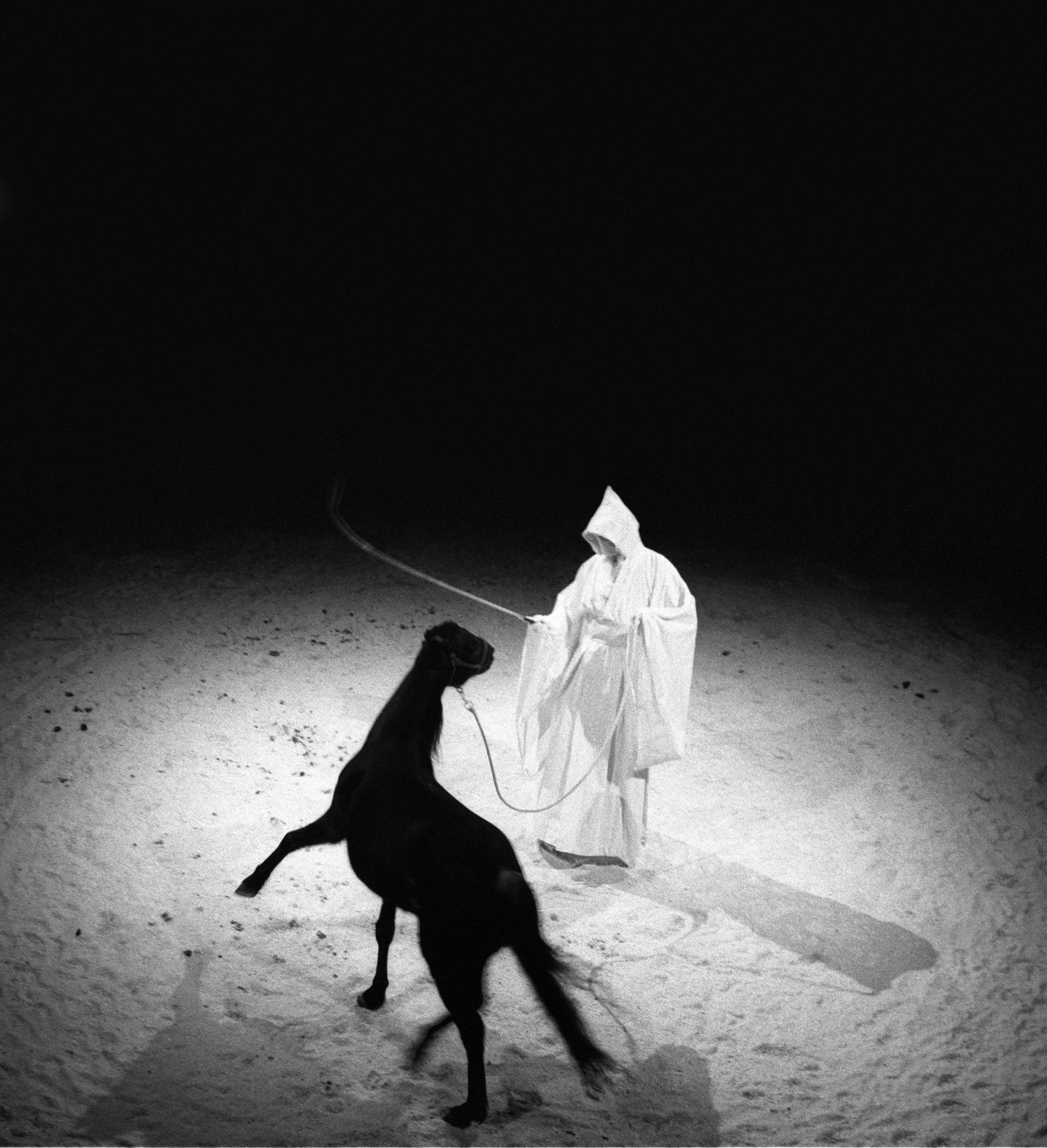
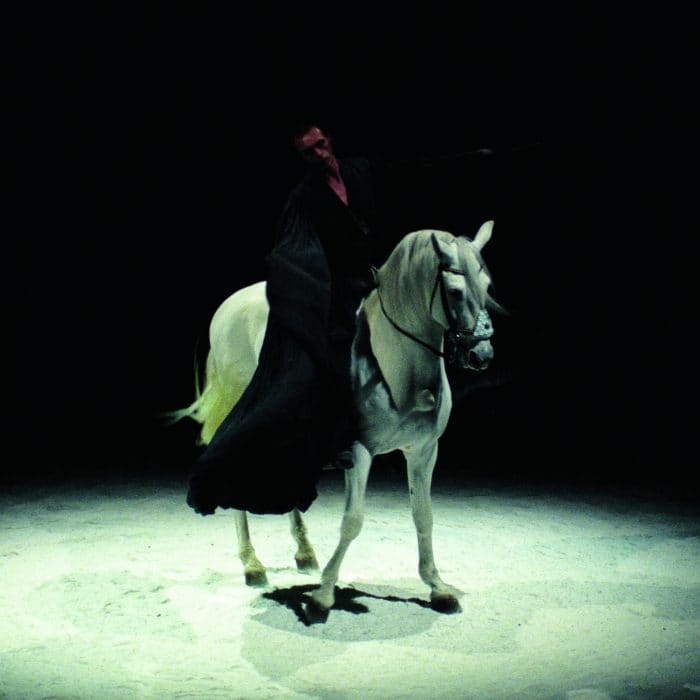
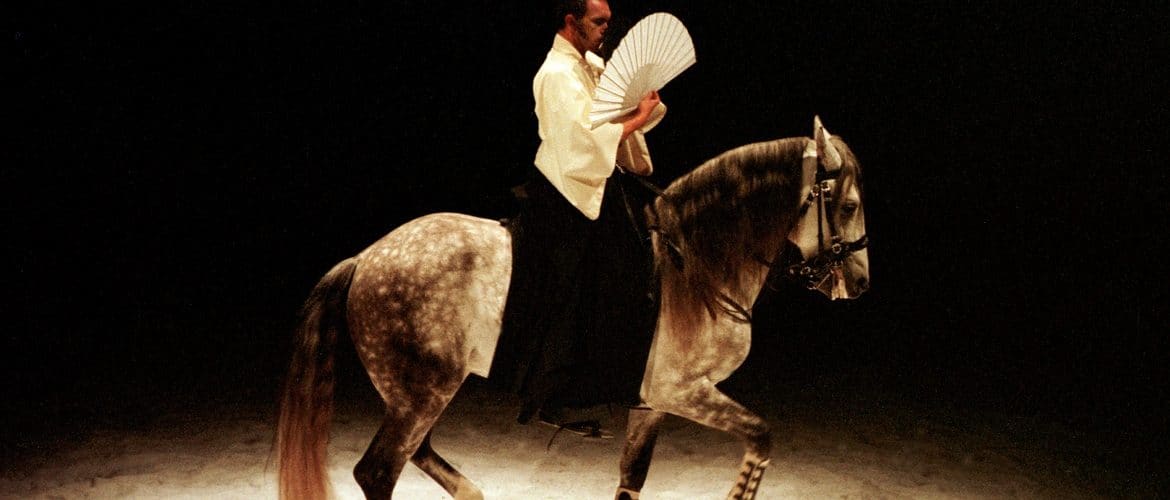
“The equestrian Theatre Zingaro is a half-man, half-horse tribe. I like this word, tribe. It indicates that its members obey unwritten laws, those of very independent people who chose to live the same adventure, to work together in the same dreams factory, and to offer what they made there to others.

I love seeing people of the company evolve over time; I love seeing them bloom, as we say about horses; not only through work but also in their daily lives, through the intensity of their presence and their relationship to time.”


ARTISTIC DIRECTOR
Bartabas
ARTISTIC DIRECTOR
TALENT IS DESIRE

“I do not know if the artists and the horses of Zingaro are the best, I know that they give their best. I want nothing else from a team member or a horse than for them to show their desire to be there, to outdo themselves, depending on their resources. My disappointment can come only from talented people who do not have a desire to give anymore. As Brel said, ‘Talent is desire’.”

Bartabas, from Manifeste pour la vie d’artiste

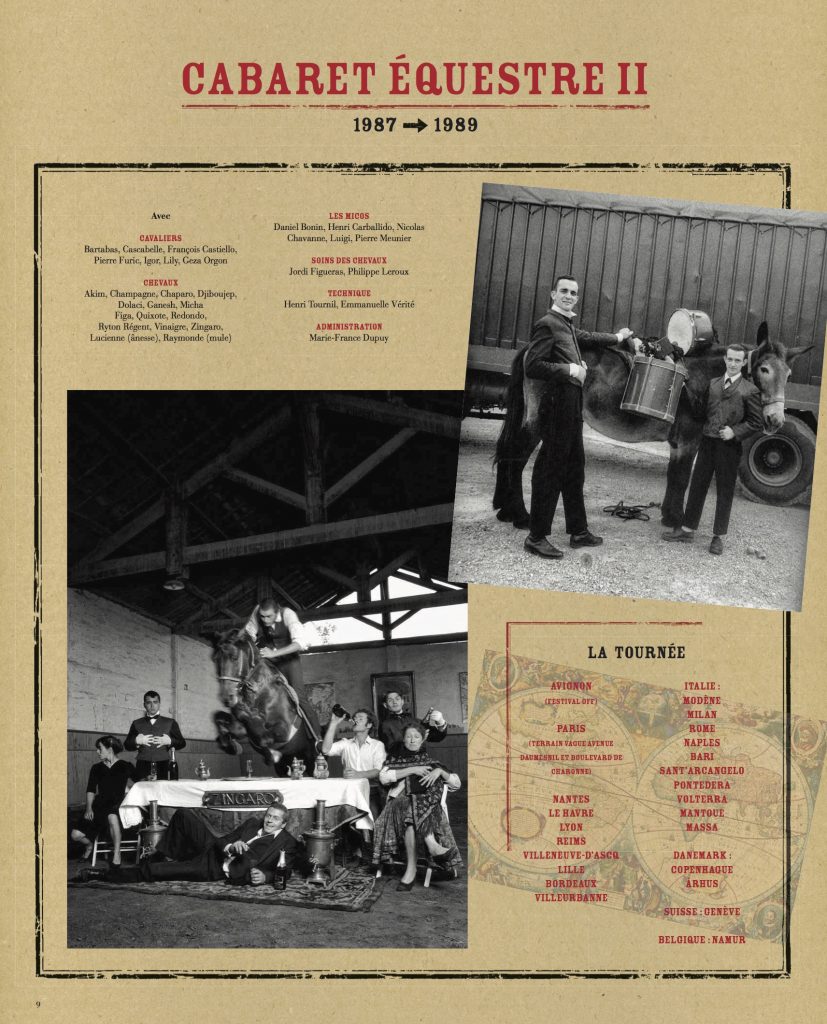
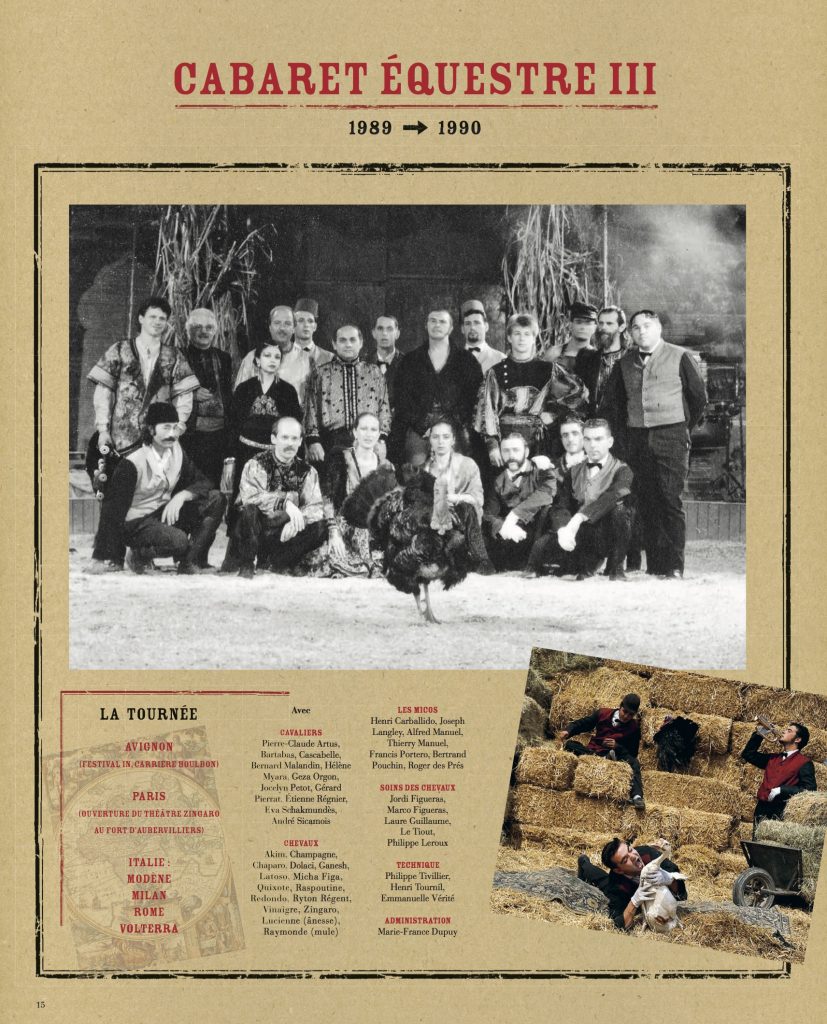
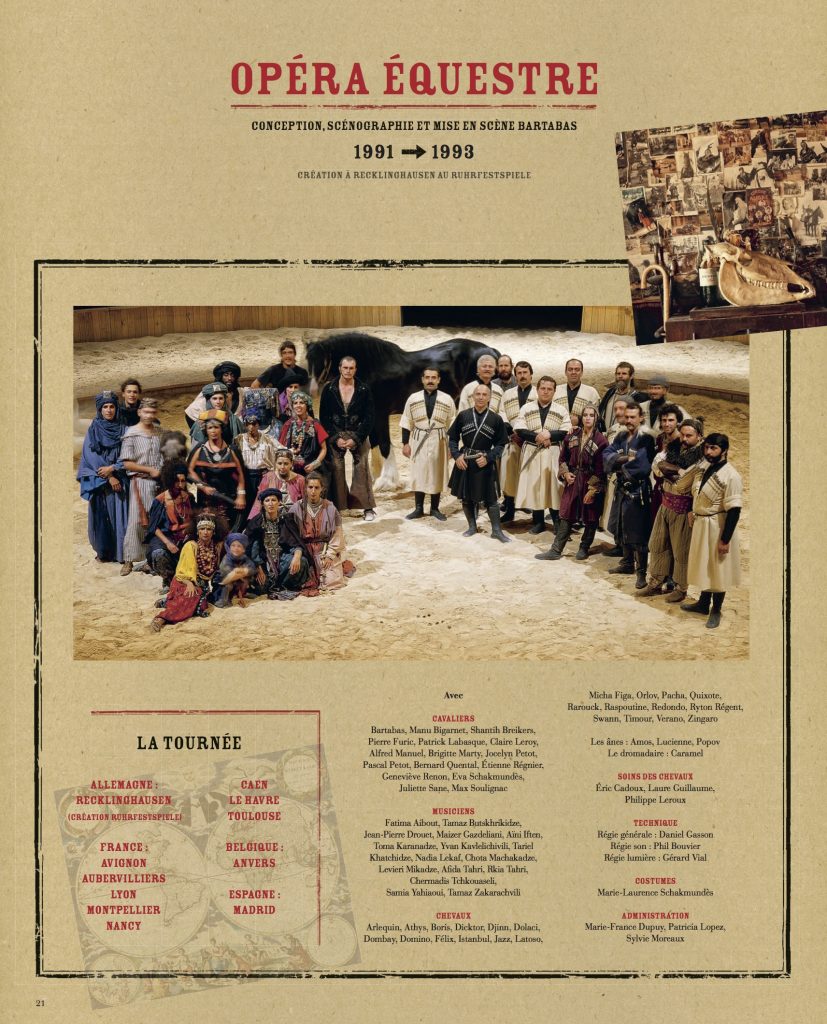
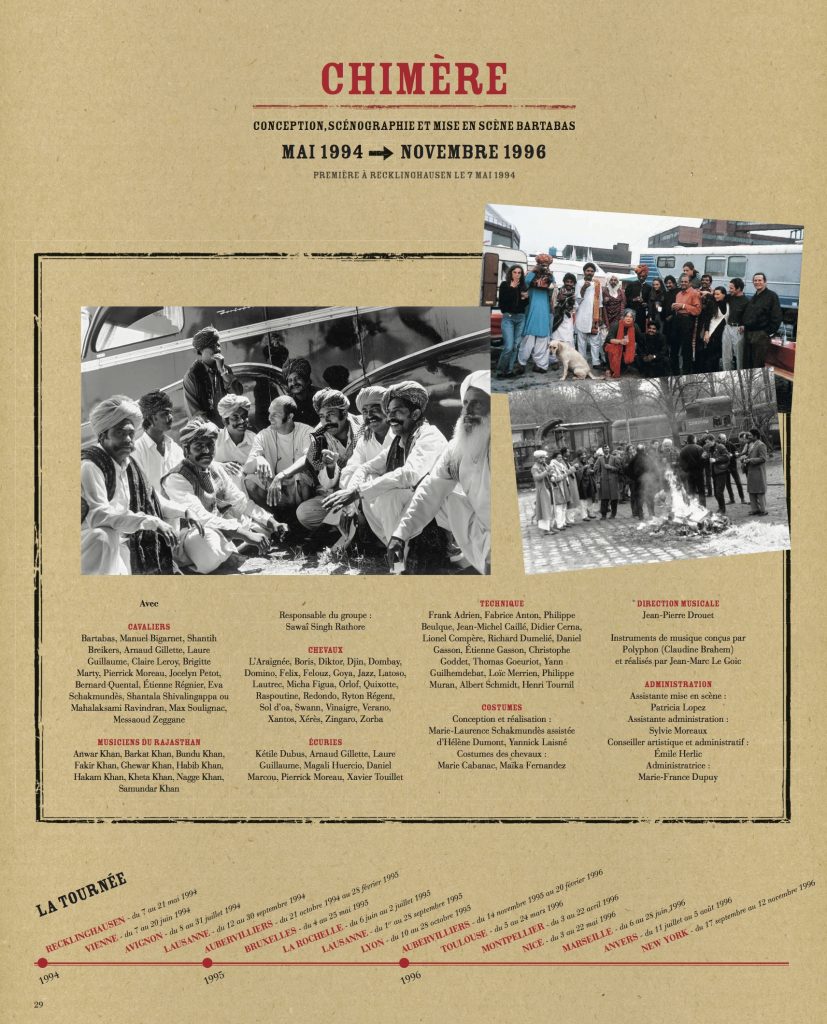
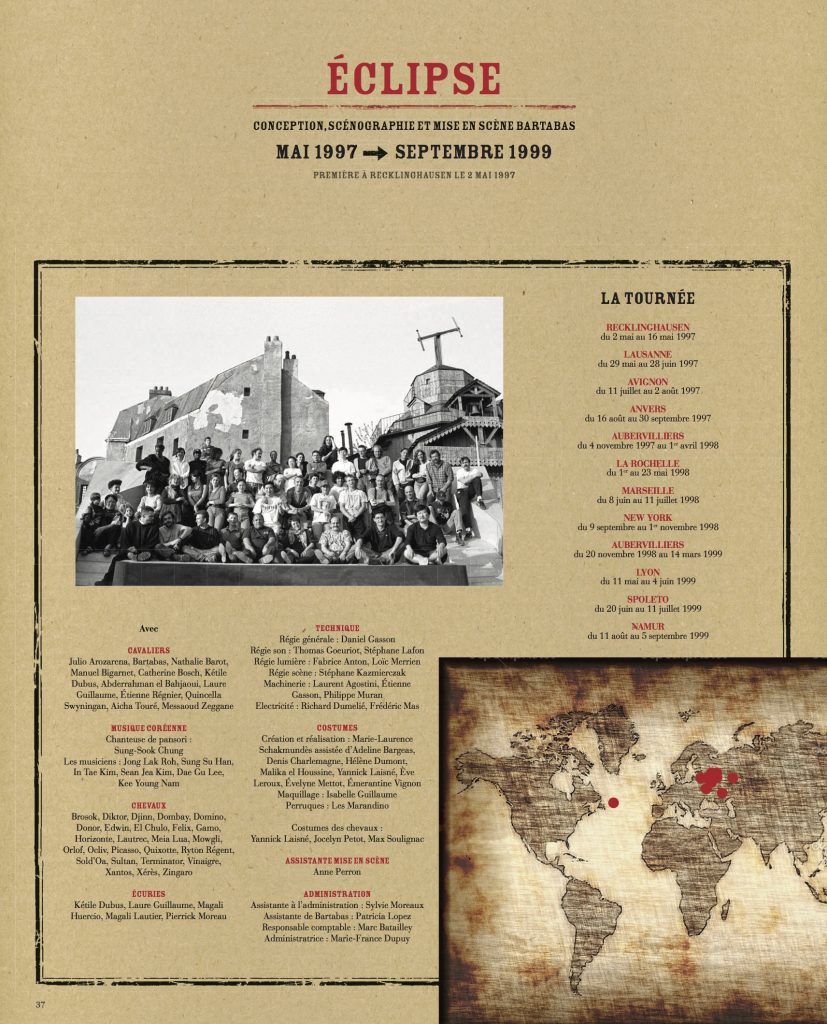
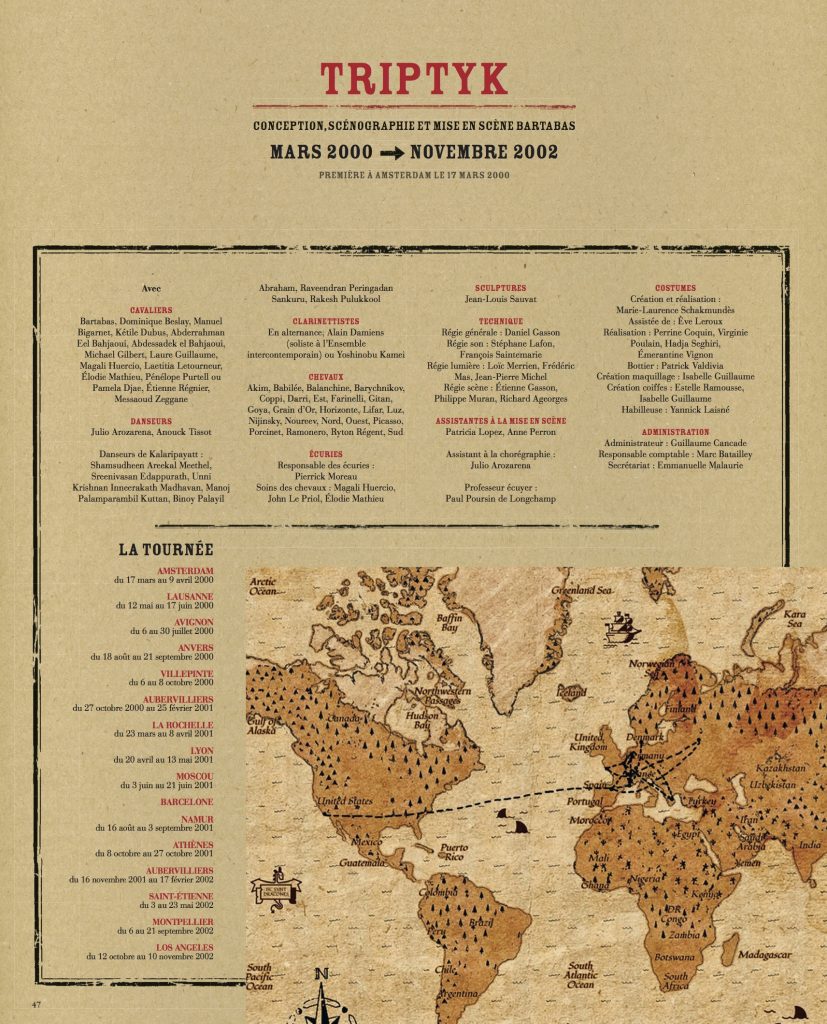
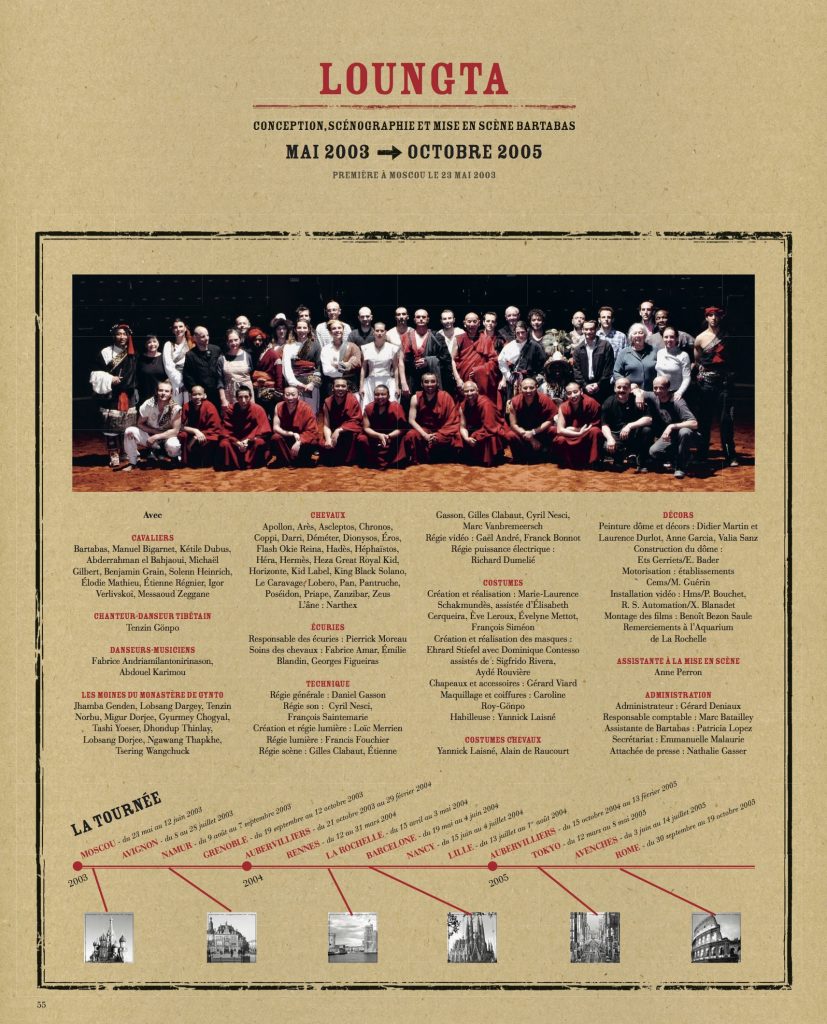
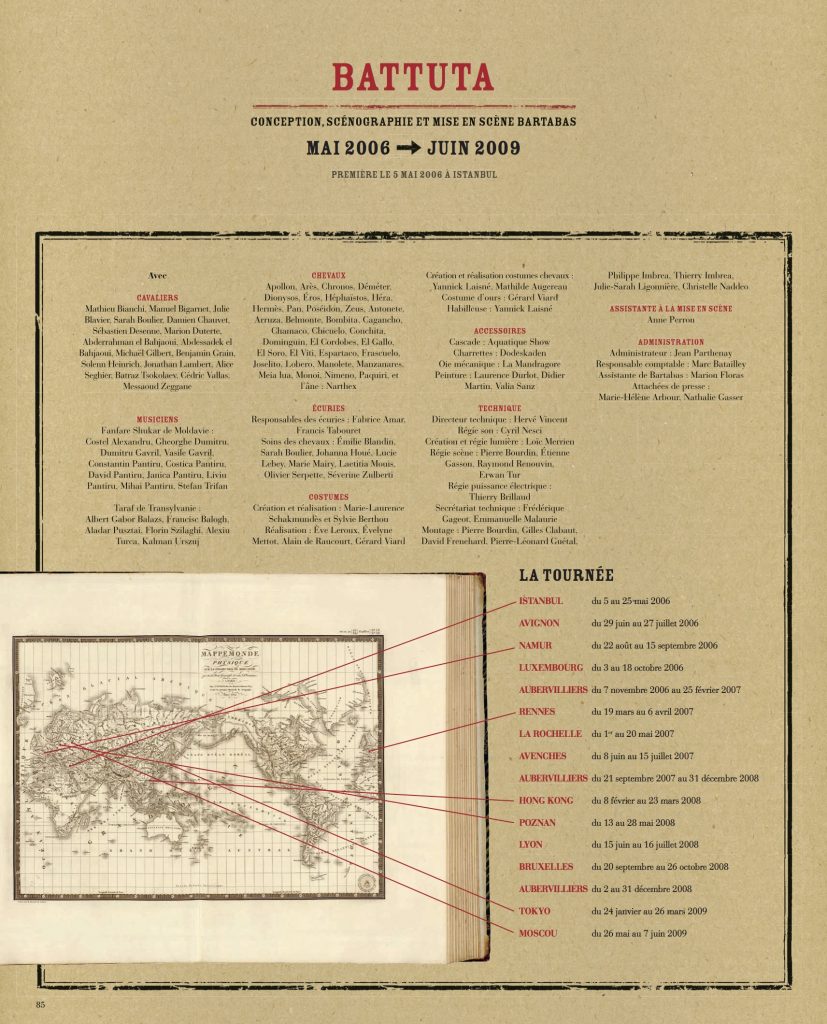
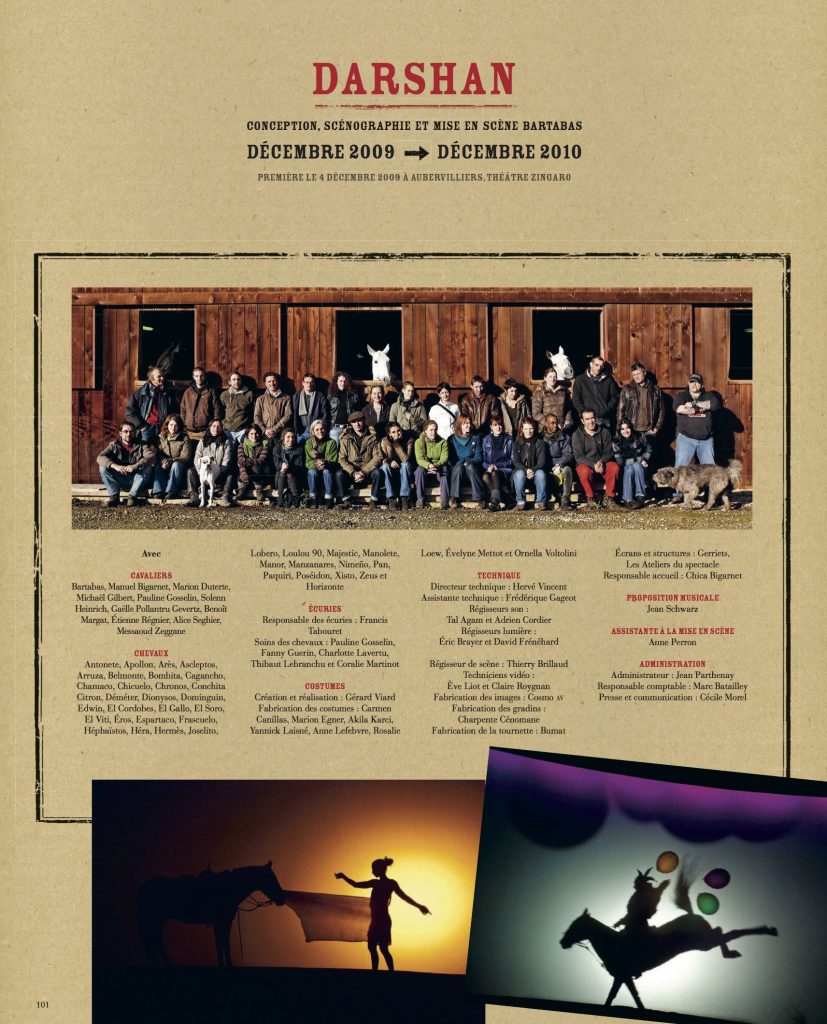
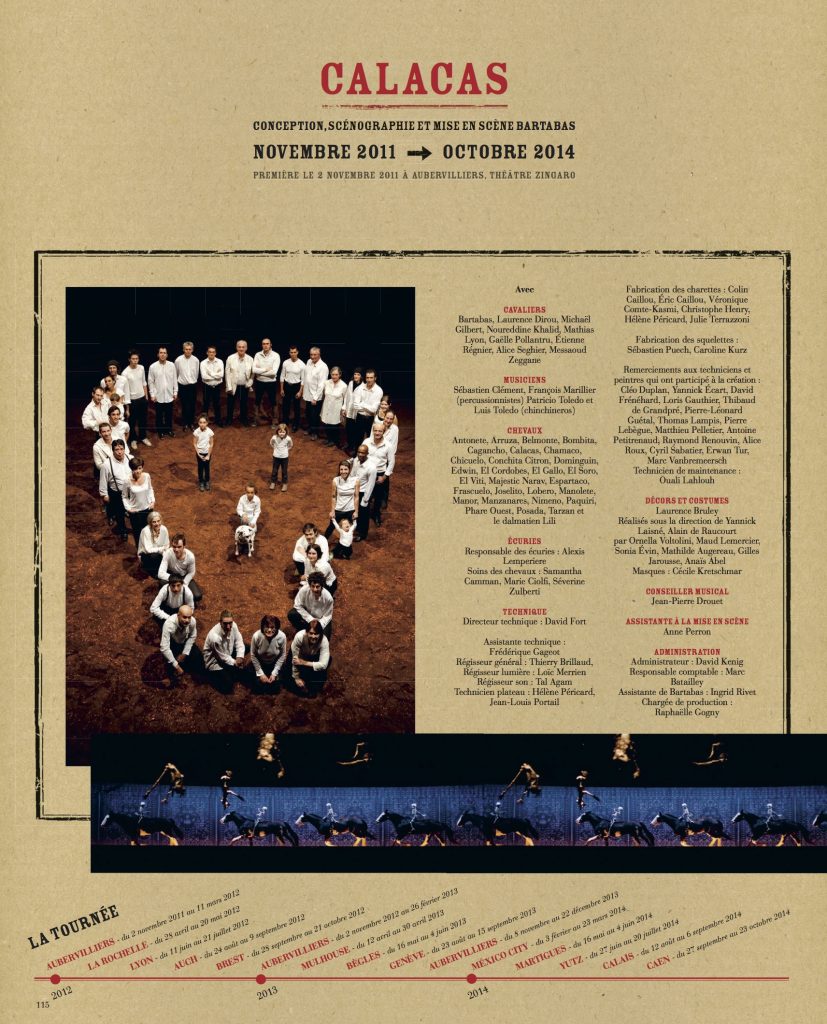
Below, from L’Almanach Zingaro, are photos of the teams of all shows since Cabaret équestre.

chronogramme
chronogramme
chronogramme
chronogramme
chronogramme
chronogramme
chronogramme
chronogramme
chronogramme
chronogramme
chronogramme
chronogramme
chronogramme
chronogramme
chronogramme
chronogramme
chronogramme

Below are some of the company’s most iconic horses.

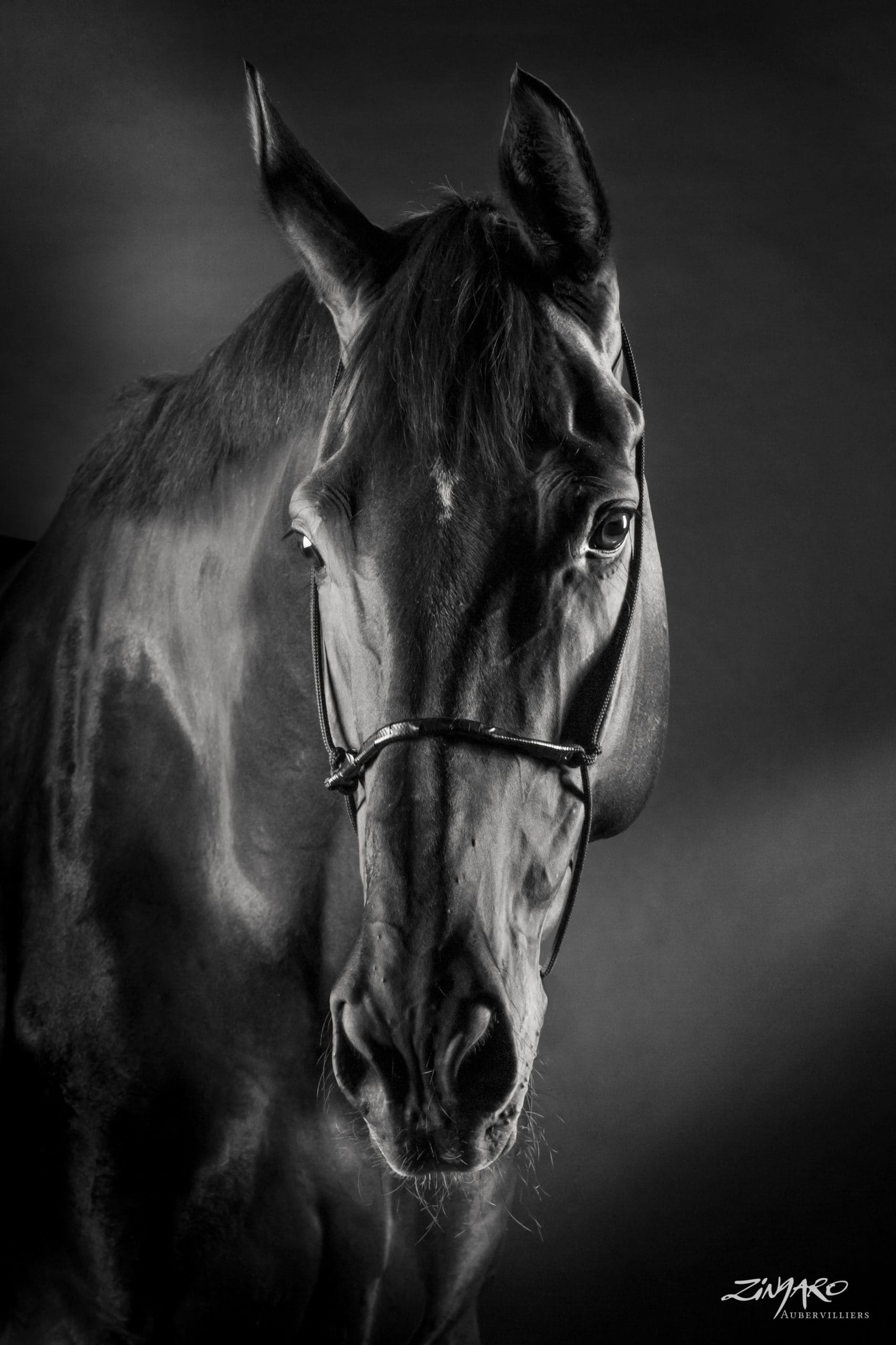
Zingaro

Zingaro

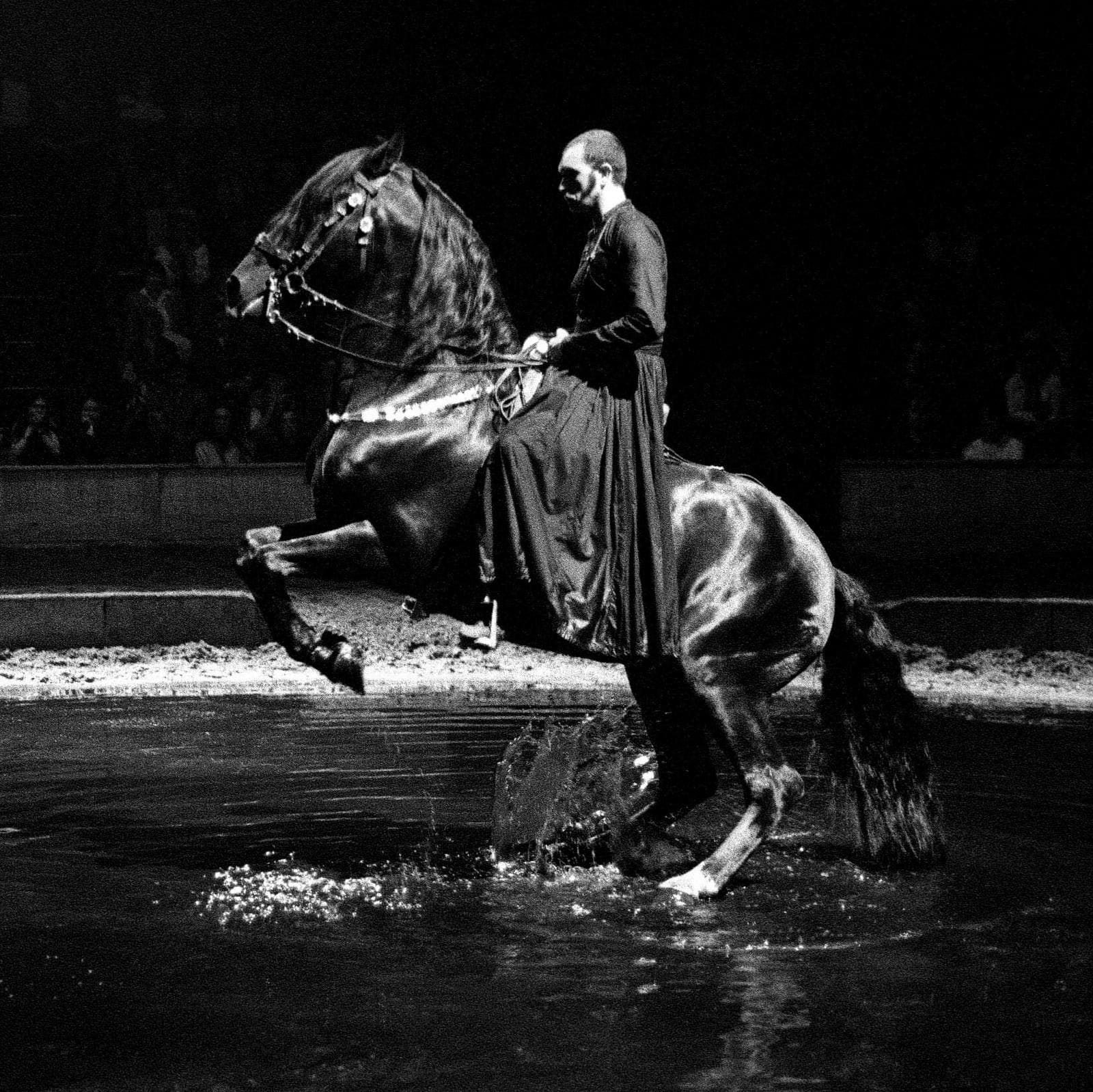
“From the temper and feigned ferocity of the Cabaret era (1984–1990), with the imposing Frisian, who claimed to devour his master, as the terrifying and youthful demiurge; the booted eagle escorting the black mastodon, known as Zingaro, everywhere; from this fiercely rebellious adolescence to the current asceticism, purity and shadow theatre, but always cavalier, everything is there, secretly inscribed on the surface of manes, rumps and necks.
The bird of prey has turned into a white goose, certainly less wild in appearance, but the flight remains.
Everyone is free to waltz with the emblems. And the horses that have disappeared are not reincarnated.”
Sophie Nauleau, excerpts from L’autre Bartabas

Dolaci

Dolaci

“A gentle, wise, moderate horse. In the stable or on tour, never a word, a complaint, a shiver. The horse is cream. Pure kindness. Was he the idol of the entire Zingaro troupe because he seemed to be Bartabas’ favourite horse? Absolutely not. He was the tribe’s beloved horse, its talisman, because horses are like humans: some are irresistible. They are there, and everything is fine, tensions evaporate, life becomes beautiful.
Dolaci was an angel.
Bartabas: ‘He was perhaps my best horse…’
The rider becomes pensive, his eyes drift away, veiled in a sepia hue, the colour of dry grass yellowed by the cold season that was the coat of the gentle Dolaci. Disciplined in his body, serious, he was an artist who kept his pace. Together, to the light strains of the cymbalum, they twirled around a garrocha (a long pole used by Iberian horsemen to sort bulls), held at an angle or vertically in the centre of the arena by Bartabas’ flat palm.
And Dolaci, in a tiny gallop, a cloud-like gallop, a powdery gallop, his head keeping time with the cotton mallets of the gypsy piano, hooded by the effort, spun like a moth around this materialised point, this spear that had no need to pierce two hearts to make them one.”
Homéric – excerpt from Zingaro – 25 ans

Quixote

Quixote

Quixote was an artist, a rare gem.
Originally, this jewel belonged to a rejoneador who came to fight bulls in Avignon. He found it mediocre when facing the bull, the bête noire of many horses, and no longer wanted it. But the sum he hoped to get for it was tidy. Bartabas tried it out, and in the blink of an eye, with a change of footing, he perceived something crazy, something unknown. The attraction drew him back the night the bullfighter was loading his herd into the van. Zartagas (as his faithful baron called him) had hidden his a few streets away. Quixote was tied to a sad wall, in the draught, his soul in torment, abandoned and unloved. As a shrewd horse dealer, our squire obtained it, not quite sure how he would justify the purchase in the accounts of the young Zingaro company.
They worked on the piaffe and the canter in place, and the animal was impeccable. One day, after observing the particular position of the squire James Fillis in an old photograph, the idea of galloping backwards, the ultimate in difficulty, tickled his brain. Even today, when Bartabas recalls the moment when Quixote took two steps backwards, his eyes light up with emotion. It seemed crazy to him, so miraculous that he stopped him immediately to stroke him.
Homéric – excerpt from Zingaro – 25 ans

Félix

Félix

It was in Italy, not far from Milan, that Bartabas stumbled upon Félix.
He was unfamiliar with the Hackney breed, which is as tall as a pony but has the anatomical harmony of a true horse and an explosive gait.
The director wanted to work on the codes of the body.
Still a foal, Félix was very aggressive. He attacked, a valiant little warrior who doubted nothing. He was also playful and a bit greedy, two significant assets for establishing a beautiful bond with the man-horse from Aubervilliers.
Apart from his reptilian convolutions at Bartabas’ hips, he would place a hoof on his companion’s thigh, like a poet, after dipping his pen in ink, with inspired punctuation, offering us a great breath of divine air.
More spirited, this charming elf, whose tail became salt and pepper, crossed his front legs and, turning into a little corkscrew horse, looked down on you better than a giant.
This cute and crunchy nibbler, a native of Lilliput,
will forever remain Félix the Great.
Homéric – excerpt from Zingaro – 25 ans

Vinaigre

Vinaigre

“I had so much faith in him,” recalls the squire.
Paired with Vinaigre, yet free to move as they pleased, their performance during Eclipse, both enveloped and extended by wings of black silk, was beautiful enough to bring tears to the eyes.
As a prelude, their winged silhouettes were projected onto the opal circle. Draped in night, the centaur’s arms opened as if to form a cross. On the ground, the erotic outline, slowly unfolding, blossomed like brown, winged nymphs that a fierce passion half-opens and then tears apart.
Then the chrysalis became an imago, baring the white, powdery forelegs of the Andalusian stallion.
With a sensual tuft of hair and eyes bathed in the sparkling glow of his coat, Vinaigre waited for a sign, a rustle of linen, a breath, a blink of an eye.
In the middle of his chest, between the tips of his shoulders, a snowball, an exuberant gift from nature, sat enthroned like an Adam’s apple in the heart of a virile throat.

Homeric – excerpt from Zingaro – 25 ans

Horizonte

Horizonte

Horizonte


“On the stage of the Châtelet, I hear my voice reciting Victor Segalen’s verses. Motionless in the darkness, I am on Horizonte. We feel like strangers in this place, and this feeling unites us.
The huge black curtain rises in German style, high up in the fly tower. Behind the cyclorama, the blue five-kilo spotlight blinds us. It’s the signal, Horizonte steps forward with determination; imbued with the words of the travelling poet, we enter the shadow theatre.

[…]

With him, I am no longer alone in my skin. Horizonte dances for me, gradually opening up and freeing himself, and I feel something very lofty. He is focused; his movements are now free from the constraints of his weight, there is gentleness in his gestures. He sets his own pace, metronomic, vibrant, almost swinging. Passage, piaffe, passage en arrière, the moment of suspension in each diagonal is a space that I welcome into the small of my back. The reins hanging loosely, his ears remain the highest point, his neck slightly bent, his muzzle well forward of the vertical, he never flinches.

[…]

My legs and hands descend vertiginously; I let myself go, opening my body and heart to his confidence… A well-understood energy never runs out.

[…]

What Horizonte offered me, I knew how to gather, take care of, assert and patiently nurture. He too wrote history, the history of Zingaro, and his piaffe gave it meaning.
You can sit on a horse’s back your whole life and go nowhere, but Horizonte took me to the limits of the imaginable. He opened up the magical space of the stage for me, where I was able to present more daring, more intimate ideas. Without horses, I would never have dared to set foot in these places where only the voices of men are heard.

Excerpt from D’un cheval l’autre, Bartabas, Éditions Gallimard, 2020

Le Caravage

Le Caravage

Le Caravage


He displays the nonchalant elegance of the English, the roundness and elevation of the Iberian, and the intensity of the Arab. Harmoniously combining the three bloodlines, he moves with uncommon strength, which he does not always control. When lunged, he sometimes explodes into sudden kicks, which immediately make him repent and tuck his tail between his legs. He carries his head high and his gaze is golden. At five years old, he knows the basics. This is where our story begins.
With Le Caravage, I move forward with an open heart, rich in the legacy of those who have passed away, filled with the love they left me. On the long road ahead, I will follow him step by step, helping him to go straight ahead. I will teach him to act as his own master, and above all, I will make lightness a prerequisite for any demand.
Caravaggio will be my Stradivarius.

Excerpt from D’un cheval l’autre, Bartabas, Éditions Gallimard, 2020
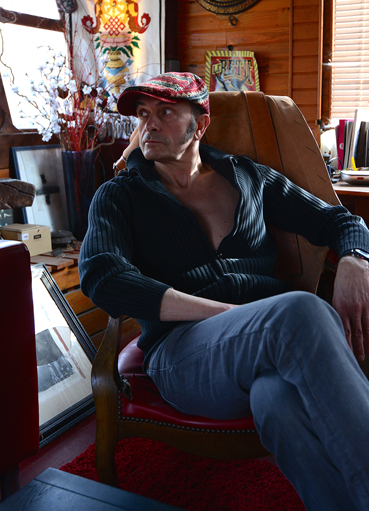
Tsar

Tsar

Tsar

Brave heart


Horses are like love at first sight; they strike you without warning. […] Immense, a monster of a horse, standing one metre ninety-five at the withers! The colour of the abyss, he defies perspective. From a distance, he looks like an old-fashioned thoroughbred, like those in English engravings; up close, he’s a black, lanky giraffe. He has to lower his head to get through the door of his stall. Even closer, his feet are as wide as frying pans. Standing against his shoulder, I find myself acting like a child again; even on tiptoe, I cannot see the horizon behind his withers. He is strong and impressive in the amplitude of his reactions; his bursts of joy are always preceded by a little squeak as a warning. But he is kind, and the candour in his eyes melts my hardened heart.
[…] He too is disabled. As a foal, his shoulder was broken in an accident in the field. Over time, the tendons and muscles have reformed and hold it in place, but the cartilage is lifeless. His ebony coat somewhat conceals the hollow of his atrophied shoulder. When resting, to relieve himself, he constantly moves his right front leg forward, shifting all his weight onto his left, whose hoof has widened and flattened. This disability binds us in brotherly friendship. I feel solidarity. For him, I will gather myself together and, with delicacy, work tirelessly.”

Excerpt from D’un cheval l’autre, Bartabas, Éditions Gallimard, 2020
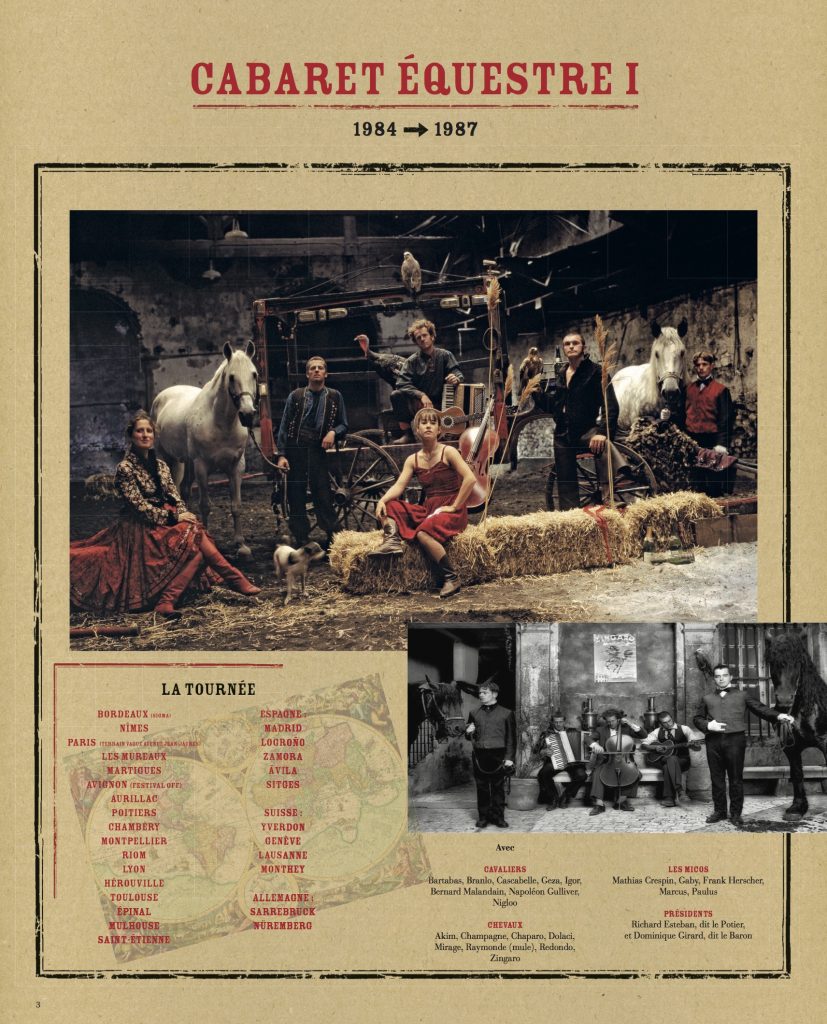
Photo © Marion Tubiana